
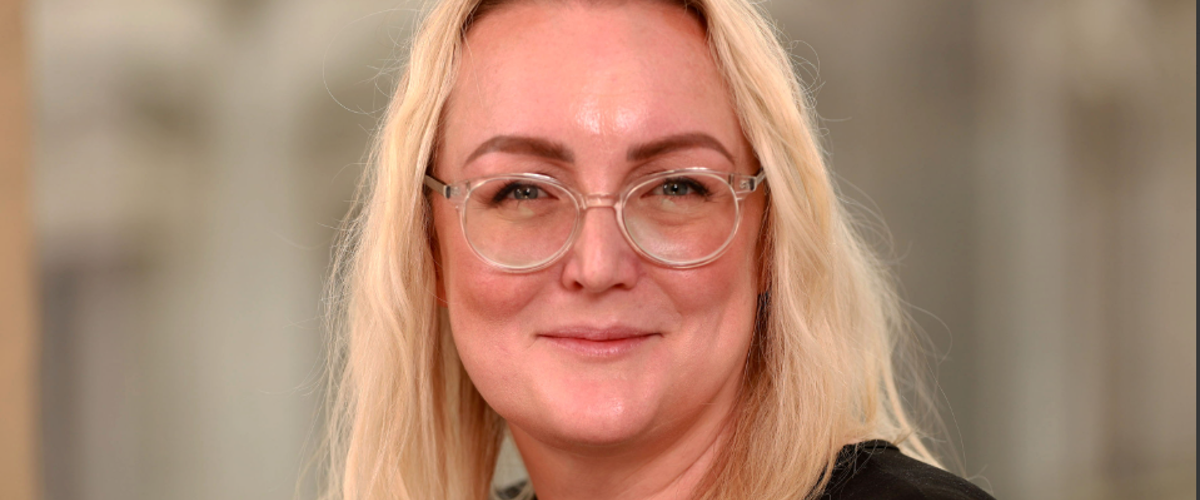
Kelly Brotherhood is a Senior Associate in our Glasgow office. For this year's Dyslexia Awareness Week, she shares with you her experience.
"I was around 11 when the word dyslexia was officially attached to me. By that point, the signs had been there for years. At four, I started at a state primary school and was quickly placed in the remedial class. I was also sent for elocution lessons, not because I had trouble forming words, but because I had a broad country accent that apparently needed ironing out.
By eight, my parents moved me to a private all-girls Catholic school. Imagine Harry Potter, swap wands for hymn books, and you’ve got the picture: kilts, cloaks, straw boater hats. Here it became obvious my reading lagged at least a year behind my classmates. But the school was different - small classes of around ten girls meant my teachers had time to notice and nurture. I made huge leaps forward.
When I moved on to senior school, the diagnosis came: dyslexia. This was 1990, though, and dyslexia wasn’t yet seen as “neurodivergence” or “a different way of learning.” It was seen as stupidity. The diagnosis wasn’t a relief. It was a label of shame, something I hid for decades.
I never told anyone at university that I was dyslexic. I studied Biomedical Sciences, graduated with a BSc (Hons), and did it all without asking for extra time, software, or adjustments. To admit dyslexia was, in my mind, to admit I wasn’t clever enough. That I shouldn’t have been there. Dyslexia meant you were thick.
After graduating, I studied law: the accelerated LLB part-time, followed by the Diploma in Legal Practice, finishing in 2009 before starting my traineeship at HBM Sayers. During my diploma, there was another student who was openly dyslexic. She talked about it without shame, and she showed me how the world’s view of dyslexia had shifted. For her, it was a badge, not a burden. She’s now an advocate.
I wasn’t there yet. I masked instead. I built systems and routines so no one would guess. I surrounded myself with people who supported me and kept going. I used “blonde” humour to protect myself. It wasn’t until the end of my traineeship that I began to be more open. The Law Society of Scotland then asked me to write an article about my dyslexia for their campaign on diversity in law. And just like that - there it was, out in the open.
Even now, with two degrees under my belt, and a diploma in forensic psychology, there are moments where a small voice tells me dyslexia means I’m stupid. That’s the old conditioning. It was hammered into us in the 90s that struggling with words meant struggling with intelligence. Thankfully, society is shifting. Dyslexia today is framed differently: as a difference, not a deficit. And I’m glad to see younger people growing up in a world where neurodivergence is celebrated.
In fact, right now I’m applying for higher rights of audience as a solicitor-advocate. That’s the qualification that allows solicitors to appear in the highest courts in Scotland and the Supreme Court in London. It’s not a path open to anyone who is “stupid” - it takes skill, determination and a sharp legal mind. The very fact I’m here, applying for this, is proof that the label I once hid from is not a measure of my ability.
And if I need a reminder, I think of Elle Woods’ (she is, after all, the reason I studied law!) graduation speech from Legally Blonde: “It is with passion, courage of conviction, and strong sense of self that we take our next steps into the world, remembering that first impressions are not always correct. You must always have faith in people. And most importantly, you must always have faith in yourself.”
I’ve also come to see dyslexia as a strength. My work in fraud depends on spotting patterns, thinking laterally, and making connections others might miss. That’s the way my brain works naturally - it’s not a flaw, it’s an asset.
The shame I carried as a child has also given me a purpose. I don’t want anyone else to feel held back by a label or made to think their brain makes them “less than.” If anything, dyslexia has sharpened my determination and made me more resilient.
So yes, I’m dyslexic. And no, it doesn’t make me stupid. It makes me different. It makes me good at what I do. It makes me me."


Neurodiversity Celebration Week - Rosie's story
I’m Rosie and I’m a late-diagnosed Neurodivergent woman in the world of work. I’m both Autistic and ADHD; which means that I have a different way of thinking and interacting with the world around me. Being Neurodivergent means that I have to put…
Read More - Neurodiversity Celebration Week - Rosie's story

Islamophobia Awareness Month
Read Farzana Abdullah's perspective for Islamophobia Awareness Month
Read More - Islamophobia Awareness Month